Thursday, December 17, 2015

In Afghanistan, Predictions Come True

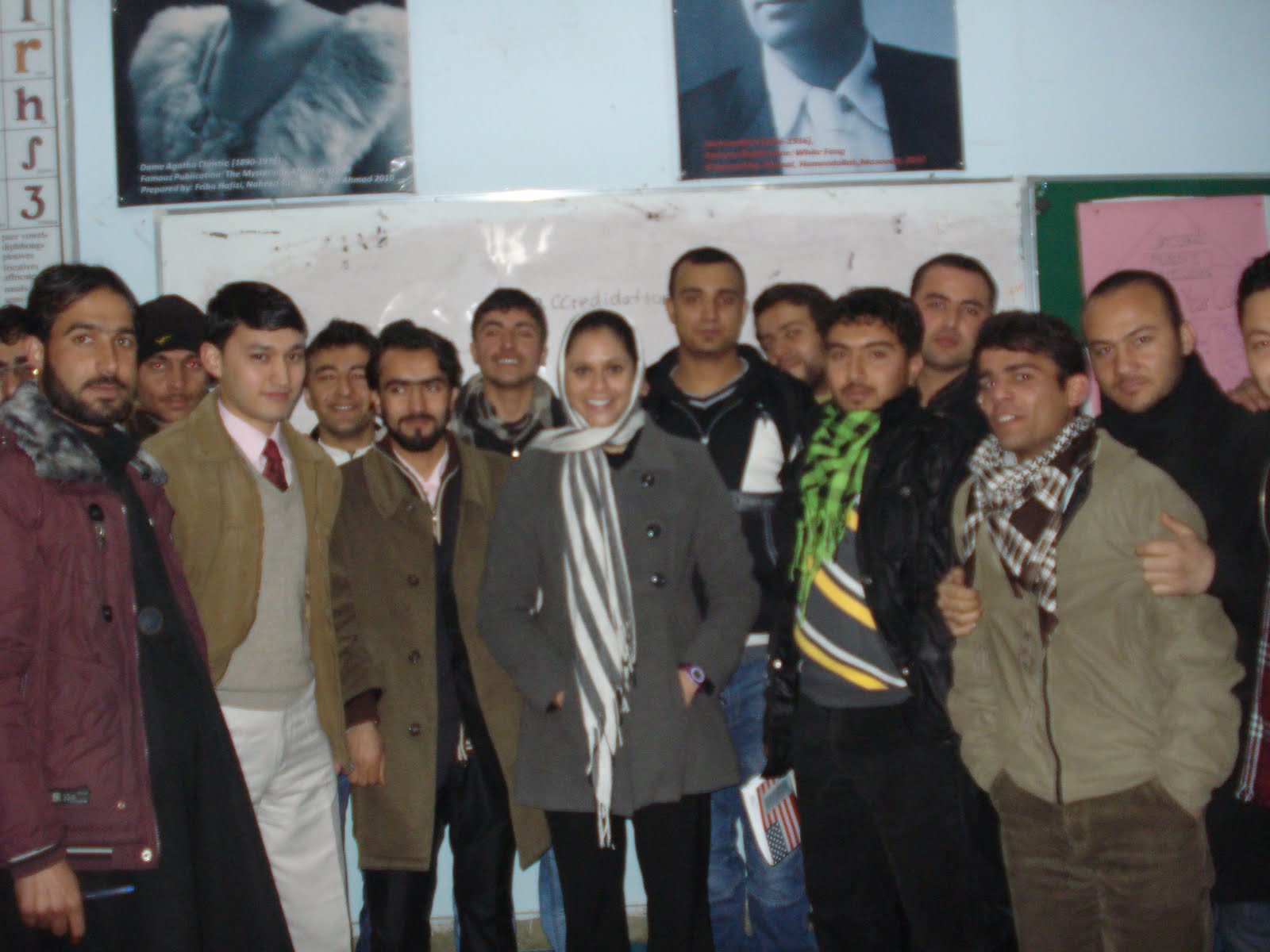
Me checking on students in writing class; Kabul Education University 2011

Award ceremony Kabul Education University (me in the green chadar!); 2012

Three and a half years ago, before doing my last teacher training in Afghanistan, I wrote about my expectations in the coming years. Many of the teachers I worked with have since completed their master's degrees, the country has become more volatile, most troops have left. These predictions came true. On the other hand, I never started my doctorate, but took on other endeavors. Life goes on and takes twists and turns; it is nice to look back and see what was, and what can be.

June 24, 2012

It starts as a low drone. Echoing baritones in the distance, haunting the morning. After one mullah starts the call to prayer, all others follow. One mosque, far away begins the wave of all other mosques in town singing Allah’s name until the mosque across the street from my apartment joins into the chorus. The loud speaker faces my window; I cannot ignore the song. Though I am not Muslim, the call to prayer is in my heart. Every time I hear it, I sing along and know that at that moment, I am probably singing with thousands of others, about to get down on their knees and offer their prayers to God. Here, the holy is in the air; I breathe it in everyday and wonder what affect it has on me.

This is my third time in Kabul and I am still amazed at the place. Each day I encounter the kindest people, the friendliest and most devout hearts. Though poverty abounds, people offer anything they can to make me feel at home and comfortable. My friends are happy and my students are ever curious. At the present, life is good in the city.

But when you dig a little deeper, you can see that it will not be this way always. Most of my friends and colleagues agree that as soon as ISAF forces draw down, the country will become much more violent. Though I know that the troops will not completely withdraw, I feel worried for my friends; I feel like their future is so uncertain. I know that the U.S. has to leave some time, but I wish that stability could be created by the people and by the ANA before the US and other nations leave.

I also think that this will be my last time in Afghanistan for a while. Though I love coming back here and teaching my friends, with the addition of the MA program it seems as though I am no longer needed here. This is great for the Afghans. It means that the educational infrastructure is developing and that things are getting better. I no longer need to come back to do teacher trainings because now the faculty is being trained in a new degree program. 

I also will not come back because I think it is time for me to move along with my life. I want to stay at my home in my country and make my own life in America better. I don’t want to have to come to Afghanistan to make money, I want to make money for myself in my own country. I want to go back to school and get a doctorate. I don’t know when the best time will be, but I am sure that will be revealed. 

I am hoping that this time in Afghanistan goes well, and that the teachers are satisfied that I have dedicated a small part of my life to being here. I hope that they are appreciative of what I could offer. Though it wasn’t much, it was part of my heart, some of my skills, and a little love.

Labels: ,

Saturday, January 07, 2012

Cheers! Kabul

New subject, same students. Many of my old students are attending my new class; I guess they have missed me!
Graffiti on crumbling buildings with no plans for reconstruction.
Haven't I seen this guy somewhere before?

Being back in Kabul after a 4 month long hiatus is interesting. During this trip back, I have had many bouts of Deja Vu; the guards at my old apartment are the same, my driver is friends with my former driver, so he knows that I like to lift weights, the policeman at the gate at school remembers that I don't eat bread, so he didn't offer any to me when it was lunch time and I walked by (he offered chick pea soup instead), the old beggar lady in burqa outside of the grocery store told me she hasn't seen me in a longtime, the biting cold is still unbearable, the walk to Camp Eggers still haunts me, I can still smell the wood stoves burning across the street from my place, my students ask me how Chris is, and the azan (call to prayer) still shakes me from my slumber before dawn.

Through all of these encounters, I can't help but think that I am Norm and Kabul is my "Cheers."

For those of you who are too young to remember, "Cheers" was a television show in the 80's about a bar in Boston. Norm was a regular at the bar and whenever he walked into the place, everyone would yell his name "Norm!" to greet him.

The theme song to "Cheers" went like this:
Making your way in the world today takes everything you've got.
Taking a break from all your worries, sure would help a lot.
Wouldn't you like to get away?


Sometimes you want to go

Where everybody knows your name,

and they're always glad you came.


You wanna be where you can see,

our troubles are all the same
You wanna be where everybody knows
your name.

As funny as it may seem, I have been singing this song in my head ever since I got here. Though I didn't necessarily want to "get away" from the happy life that I live in the states, I did want to come back here to remember how wonderful my life really is. Just as I have written before, I think it is necessary for us to leave behind what we love in order to realize how amazing the things that we have are. So, I have gone away to Kabul to remember how lovely my life is in America.


It is ironic that the place I have to go where everybody knows my name is Kabul. Afghans are awesome like that. They have the best memories of any people I have ever known. If you tell an Afghan something, they most likely will never forget it. But you have to be careful, Afghans expect the same from you! I remember that one student told me how many siblings she had, and what all of their names were. She felt bad later on when I asked her again about her siblings and what their names were. Testing her, I asked if she remembered all of the things I had told her about my family, and she proceeded to repeat all of the information I had mentioned the week before. So this, it ends up, is the place in the world where everybody (who has met me!) remembers my name. Go figure!

And finally, here, everyone's troubles are the same. It is true, our troubles are all pretty similar in Kabul. From the poorest person on up, we are all cold, we all are hoping for clean air, clean water, and clean food, we are all hoping for peace. Though the foreigners here have all of these things outside of the country, temporarily they have to live alongside their Afghan counterparts and experience a fraction of their suffering. We all worry about suicide blasts, inclement weather, illegal checkpoints, and kidnappings. We all worry about money and time. We all go to sleep hoping to wake up to a better day tomorrow.

So, as I wander through these familiar streets, consistently being greeted by people whom I know, always seeing things I have seen before, I can't help but think: I am Norm and Kabul is my "Cheers."

Labels: ,

Monday, December 05, 2011

Altitude Training

View of the hills from Babur Gardens, Kabul.
Hanging out at Afghan Culture House, Kabul.

With the absence of oxygen, a human will die. But, strangely, with just a little oxygen the human body will become stronger.

Ever since the 1968 Olympics, which were held at about 7,000 feet altitude in Mexico City, Mexico, people have been curious about what competing at or training at altitude does to the body of an elite athlete. Many people were worried that the decrease in oxygen available at such heights would adversely affect the performance of endurance athletes, but that the thin air would cause less air resistance and help out anaerobic (sprint-oriented) athletes. The hypothesis was roughly true; many records fell at the shorter distances during those games.

After the Olympics though, the curiosity about altitude's affect on athletes did not fade. People began to realize that there are definite and measurable benefits to training at altitude and competing at sea level. While training at altitude, an athlete's red blood cells increase, VO2 max is heightened, and EPO also has been proven to increase. All of this means that an athlete's body adapts to working with less oxygen. When people who train and live at high altitudes return to sea level to compete, they are able to use the abundance of oxygen at lower altitudes to their advantage.

Though it happens slowly and for better or worse, an amazing characteristic that all humans possess is the ability to adapt to challenging circumstances.

In two weeks, I will be doing a little altitude training of my own; I will be returning to the beautiful, yet tumultuous city of Kabul, Afghanistan.

Returning to Afghanistan is altitude training at its finest. Not only will I be pushing my athletic limits in the thin air of this 6,000 meter high land, I will be navigating the politically tense and economically depressed reality of daily life in a city that has been at war for three decades now.

Why am I going back to Afghanistan when I have just recently returned from a 10-month long teaching fellowship there? The short answer is, to teach. I have been awarded a grant by the Department of State to return to the University to conduct a teacher training workshop.

Another answer is, How can I not?

How can I not return to a place that is in desperate need of education, when I have the skills to help, and the means to go there?

How can I not return to a country that is at war, partially due to the fact that an uneducated and illiterate majority were strong-armed and conned into believing that the Taliban would rule them with a fair and objective hand, when I know that the education I can offer them will chip away at the ignorance which has landed them in this situation?

How can I not return to a city that welcomed me with open arms, and asked me to be part of their family, part of their history, part of their lives as if I was their sister or daughter?

Being back in Kabul will be challenging. Not only will it be harder to breathe, but it will be harder to ignore the poverty and injustice that is rampant in that land. It will be a strain to feel the dust in my lungs, to see the bombed out buildings, to hear the widows begging for a cent or two, to listen to the sad stories of my friends. It will be a test of both the body and the spirit.

But I welcome this experience with an open heart and mind. Just as the absence of oxygen will make me a stronger athlete, so will the testing of my spirit make me a better person. Being with my friends in Kabul, living their lives, knowing their hardships and their happiness, reminds me why life is so special. Without challenges, how would we ever know how good life is; without adversity, how would we know how strong we are?

This is "altitude training" at its best. This is why I am returning to Afghanistan.

Labels: ,

Thursday, July 14, 2011

Bittersweet Afghanistan


Night time has arrived and I am waiting to go home. For me, my time in Afghanistan has come to an end; after one week, I will leave this place. I will leave my chadars (head scarves) behind and slowly unfurl my American self again. Though the details of day to day life may fade, I will never forget my time here; Afghanistan, and especially my students, will always have a place in my heart.

One of the last things that I taught the students in my writing class (before their final exam last week) was the idea of oxymoron. We talked about the word "bittersweet," and I asked my students to tell me a situation in their lives which was bittersweet. This is what they said:

"I am about to be married. I am very happy that my family has found a suitable and good boy for me to marry, but I am afraid and sad to leave my own family behind when I must join his. Getting married is a happy change in a girl's life, but leaving her family is terrible. This is bittersweet."

"When I was very young my family moved to Pakistan to leave the country [Afghanistan] during the Taliban. I lived in Pakistan for 14 years. When we returned to Afghanistan, I had to leave all of my friends, my home, my city, and all of my favorite places in Pakistan behind; I had to make a new life here. I was coming back to my real home, but leaving my childhood forever. This was bittersweet."


And, unprompted, the head of the English department at my University said this at my going away party yesterday:


"Jaala Jan is leaving us. This is both a good and bad thing; it is a bittersweet moment because she will return to her home, but she will leave us. We have come to know Jaala Jan as one of us. Look, she is Afghan! She will remain in our hearts forever; we will always pray that she returns one day."


Leaving Afghanistan is bittersweet.


As I leave here, I will always remember both the good and the bad; I will always keep these memories with me:


...the call to prayer (azan)echoing in the background of life, almost always a constant reminder of the Muslim faith that guides the people and fills the air


...the clip clap of donkey and horse hooves on the streets; the bump of their carts wheeling over uneven ground, dumping potatoes and onions here and there


...helicopters interrupting class, shaking white board markers off of their trays


...Farhad Daria and Ahmad Zahir blaring on everyone's radio; playing over and over again in everyone's head


...4:45 am summer sunrises


...the smell of rotting garbage and rancid standing water lining the streets; the vision of the car wash boys dipping their towels in the sewers to give the cars a quick "bath"


...gravel in my beef


...a river choked by carelessness and trash


...the huge hearts and effervescent kindness of the people


...invitations for lunch; mantou, boolani, oshaq, kofta, kabobs, and gigantic naan


...Crossfit Camp Eggers; a little slice of America, the place where I found my heart and fell in love


...herds of goats stopping traffic


...Toyotas...everywhere


...cows getting gutted on the side of the road; a stump for a butcher's block; a strung-up sheep waiting for slaughter, staring at the severed head of another sheep lying by the gutter, blood flowing freely


...the sunset overshadowed by the brown dust of yet another wind storm


...70 Afs DVDs at Finest


...thinking every clap of thunder is a suicide bomb


...the view of T.V. hill obscured by my window; sitting in the prison of my apartment, wishing I was free


...burqas held tightly over eyes; women covered by men's insecurity

...darkly lined eyes, colorful make-up, and a stray tuft of hair peeking out from under a chadar; fabric tucked behind an ear, daring you to take a closer look

...policemen and soldiers roaming the streets; sentries without a clear purpose, weapons ready, always in danger


...mountains beyond mountains, holding secrets from decades of war that will never be revealed


...mud brick walls and houses, crumbling under the weight of corruption


...barbed wire strewn over everything; protecting nothing


...self immolation to end the suffering and imprisonment


...Rabia Balkhi's poems lamenting all women's sorrows; but dreams as well


...love stories written in secret, eyes glancing at each other from hundreds of meters away; sparks that will never start a fire, extinguished by an arrangement


...roses growing from every crack, fertilized by dust and hope


...mischievous smiles, ensuring that the future will be better than the past


And so, as the night becomes darker and I fall asleep, these are the things which will never be forgotten; this is Afghanistan to me.

Labels:

Friday, April 01, 2011

A Bridge, not a Barrier

Winter Speaking course students.
Certificate ceremony for my winter Speaking course.

After wars have been fought, battles have been executed, people have died, land has been destroyed, and a generation of people have suffered through a surreal life, everything will end with a few people in power sitting down, drinking tea, talking, then deciding the future of a country. Peace will depend on negotiations made between victorious parties; Afghanistan's fate will be determined by a small group of people. Hopefully that group of people will not consist of those who have killed the most people, acquired the most weapons or money, or burnt the most schools. Hopefully that group will consist of the educated; the people who have a vision of a peaceful, equitable society. Hopefully that group will be my students.

But right now, Afghanistan faces some barriers in achieving my hopeful reality.

The first barrier is the American people and military.

Mentioning this is important. Americans who know nothing of the three decades of conflict in Afghanistan have decided that it is time to pull our troops out of the country. Popular opinion seeks to "bring our troops home;" to end our exorbitant military spending and to wash our hands of this place. This is a valid position. After all, who wants to be spending so much money in a Central Asian country roughly the size of Texas that has seemingly nothing to offer us? Who wants our military personnel dying each day for a lost cause? Who prefers to funnel billions of dollars into a place run by one of the most corrupt governments in the world? I don't.

But consider this: Disarming (by this, I mean not giving anyone here any more weapons) and educating the people of Afghanistan is in our interest. We are all, Americans and Afghans specifically, members of a global society and to allow any country to remain poor, underdeveloped, and uneducated poses a threat to not only the welfare of the people within this society, but to the rest of the world.

Poverty and conflict breed ignorance. When people are uneducated, they lack the ability to make decisions for themselves; to research issues, to read a newspaper, to simply sign their own name. Illiterate people cannot attend schools and will never learn the skills they need to build an economy, the infrastructure, to develop technology and industry, and to enhance and strengthen the education system. Illiteracy paves the way for discord. Bad people can tell an uneducated populace any kind of inaccurate information and the people will believe it because they don't have the ability to disprove it. Uneducated people anywhere is a threat to peace everywhere.

A key component in nation building is not wealth, but skills. Right now, a great deal of the billions of dollars we spend in Afghanistan contributes to the military presence here, not to the educating of people. Although there is a percentage of soldiers working in reconstruction teams and with the people, training them to do their jobs (most of the training is with the Afghan National Army and Afghan National Police), not enough is being done to enhance the Education system.

If the military really does leave, and we pull all of our money out of this place, a vacuum will be left where the security forces once were. Who knows what may fill this vacuum in the absence of education.

But there is hope.

At this point, America could be a bridge rather than a barrier.

At this point, America can make the decision to replace military spending with skilled professionals to train Afghans in teaching, business, engineering, medicine, and all other fields which support the development of a nation. I suggest that as we pull soldiers out, we replace them with educators; with people who can teach skills to the citizens of Afghanistan. I stand my ground when I say that ignorance and illiteracy are the biggest hurdles to peace in Afghanistan. If we as a capable, generous, developed nation gave Afghans education rather than money; if we as a free, hopeful people gave Afghans training rather than military occupation, everyone would be better off. Knowledge can never be taken away from someone, but money, goods, and weapons can all disappear.

Let us be a bridge rather than a barrier.

The following is a speech that my student wrote for an embassy event. He is a senior at my University and one of the people I hope ends up at the negotiating table when the war comes to an end.

In the name of God, the most merciful


In my own life, I have always thought about when I would find an opportunity to open my heart and present my people’s problems. Well a man must not be hopeless, because God is more kind than we think. Thank God now I have the opportunity.


Today I apologize, but I am going to spill the beans about my government regarding both education in general and higher education. As an Afghan citizen I must tell the truth. If the government of Afghanistan, the World’s Society and the people and government of the US do not focus on education in Afghanistan, especially on higher education, I believe that after three or four years Afghanistan will become a leaking nuclear reactor; a disaster which no one can do anything about it. Afghanistan’s opposition forces will increase, and at that time a hundred years of battle and war will ensue in Afghanistan. There will be no peace and no security in this country.


In the US there is NASA and in Europe there is ESA, they are both the results of education. But if there are suicide bombings, if there is violence,if there is burning schools, if there is killing innocent people and so forth, these are all the results of lack of education.


If today there is no peace in Afghanistan, it is for the lack of education, if the opposition groups burn schools, they don’t know, if Afghanistan is backward again and so forth, these are all the results of lack of education.


I want to say to the people of the US, the US government and to the World’s Society, if you want to bring peace to Afghanistan, if you want to finish the terrorists, if you want to achieve your goals, if you want to complete your responsibilities as a human being, then focusing on education is more effective than battles and wars.


We thank the World’s Society and the people and government of the US for their help in Afghanistan. Today we have schools, we have universities, we have teachers, and we see that cute and small children go to schools, young and fresh boys and girls go to universities, but I want to say please help us to expand education all over Afghanistan and build a new and desirable education system in this country. The education system here is more traditional, centralized, closed and ineffective; we need help.


Besides not having a better education system we have got many other challenges as well. The first challenge is lack of schools and universities. In this year almost 75,000 students couldn’t find the opportunity to study in universities. As the statistics predict, after three or four years the number of students who are not admitted to Universities will be 1 million students. 1 million young, powerful, educated, and brilliant students will be result less. Who can guarantee that they will not join the opposition forces? Who can guarantee that they will not join the violence? Thus, I request from the government of Afghanistan to spend the remaining of other ministry’s development budget on education and higher education. The 5 million which was spent on higher education this year was not enough. Besides this, I request that the US government and people as well as the World’s Society send us teachers instead of money. We need knowledge rather than dollars.


The second challenge today is that science, education, and technology are developing at the speed of a fast-running car, but Afghans are walking at the pace of an ant trying to catch that car. Still most of the people who live in rural areas which cover 65% of our population don’t know what a computer is. Thus, I request from the US government and people as well as the World’s Society to give us some scholarships, academic exchange programs to help us build the quality of our education system.


There are more than a hundred problems I can think of, but if all of them were presented now, we would need more than three hours just to list them. If I find an opportunity to help my people, my first work will be to change the education system as well as expanding education in Afghanistan. Thanks for your patience.

Labels: , ,

Friday, March 11, 2011

Kabul Break

Empty, snowy Kabul Education University.
Visiting Babur Gardens, Kabul, with the new ELF Amy. Bullet holes still riddle the mosque.
The view of Kabul from Babur Gardens.
My Afghan friend's daughter making "Crossfit rings" soup.
The kids and me cooking in my kitchen, Kabul.

Night has fallen and I am no longer alone. Though my apartment is still cold and empty, new friends and activities have filled my life. Five months ago, I wrote of being imprisoned in my own home. Now, I still face the same challenge of not having freedom of movement; of not being able to make my own choices about many small things that we take for granted as citizens of a free and peaceful country, but in the space between the loneliness and wanting, life has grown around me.

After returning to Kabul from my trips to India and Nepal, reality slowed down like a slug on a cold winter morning. I returned to an empty University, a freezing apartment, unforgiving snow, friends gone on vacation, and not much to do but work out. My Kabul break had begun.

Fearing that boredom, loneliness, and quite possibly insanity may set in, I took to working out twice a day, writing letters home, studying Dari, and planning my semester. Though idle hands usually would cause much mischief in my seemingly unadulterated real life, here it just makes me fantasize about taking a long walk outside.

Thankfully, crossfitting and spending time with friends has filled my break time with much-needed socializing. During my winter break, I have spent time with students, entertained the new English Language Fellows by taking them to Babur Gardens and out for dinner (I know, it is a little crazy!), gone shopping for clothes in the local mall, attended lessons at Dari school, gone to my University to do some work and toughen up in my unheated office, cooked, spent time at Camp Eggers doing crossfit, and invited my Afghan friend's family over for lunch.

Surprisingly, life has been quite pleasant during this break time. I still find myself gazing out of my window towards Television Hill, wishing that I could throw off my chadar and bound up to the summit. Five months ago those peaks seemed thousands of miles away. Now, they are closer than ever.

Recently, I was invited to go and explore those hills. Though I won't be running to the top, when the time is right, friends will accompany me to one of the highest points in Kabul where I can look down on the city from a new perspective; when I arrive on the mountain, I will say my prayer of freedom, just like I promised so long ago. Only this time, I will say it not for myself, but for this humble city of Kabul. For now I know that anything is possible.


Only five months ago I felt as though I was alone, in prison. Now, the peaks of mountains are at my fingertips. If life here can blossom into a beautiful, friend-filled existence in such a short time, maybe the same can happen for the city itself. Only time will tell.

Labels: , ,

Saturday, February 12, 2011

Drop by Drop

The future teachers of Afghanistan!
One of my favorite "drops in the river;" a student receiving a certificate of completion at one of my courses.
More quality "drops..."

Some people are considered hopeless romantics. They go around wishing for silly things to occur like love at first sight, tulips to bloom in winter, music to actually burst through the sky to accompany them on their everyday tasks, and for world peace to blanket the globe. These people are considered romantics because all of these things could probably only happen in an ideal alter reality; they are considered hopeless because this reality may never occur. I am here to tell you, that if ever there was a time for hopeless romantics to grasp on to their otherwise defined as "idealistic notions," it is now.

Admittedly, I am one of these people. Lately I feel as though it is an appropriate time to explain why my chosen point of view is not hopeless, but HOPEFUL. Yes I am an idealist. Yes I believe that one person can be the catalyst for bigger things to happen. Many times people have told me, "it is so nice to be optimistic all of the time, but you are just one person and one person cannot change anything." Obviously, these people are not idealists. Obviously, they haven't read the news lately (Re: Egypt) or met my students in Kabul. Let me elaborate.

First off, hopeless romanticism (reckless idealism?) has just caused one of the longest standing Arab regimes to fall. If you hadn't noticed, President Mubarak of Egypt just stepped down because of mass protest by the people of Egypt. I'd like to wager a bet that all of those people didn't show up in Tahrir square 18 days ago because of a coincidence. No, I would presume that one person started a discussion with another person a few years back about how much they were dissatisfied with the oppressive regime. This discussion spread to many other people and, what do you know...a regime has now fallen.

Second, I get to work with the youth of Afghanistan, teachers in training, everyday. Amidst all of the governmental corruption, poverty, and war, my students show me daily how brightness can emerge from these desolate times. Not only do they discuss a future devoid of war and violence, but they do something about it. They are teaching their students how to be better people; they are eradicating the most destructive weapon in all of this country, illiteracy. All of my students know that they can't change the state of their country immediately. But what they do know is that by educating the people, one by one, they are building a better nation.

So what do the Egyptian people and my students have in common?

Not only do they both weave idealism into their world view, they know that one person can change things. This is how it happens, one person has a hopelessly romantic dream of a different reality, then they tell another person. The other person passes this idea on and then it moves through a population in this fashion. Pretty soon, a bunch of people believe in this once hopeless idea and it becomes a reality. It is that easy.

Last week, before I knew that the regime in Egypt would fall, I learned an Afghan proverb; it immediately became my favorite. It goes like this:

"Qatra, qatra darya mesha."
Drop by drop, a river is made.

Of course, this applies to both Egypt and Afghanistan. Twenty days ago nobody would have thought that President Mubarak would be out of office within the month. Now, because the people, who are all just drops in a huge river of humanity, have come together to protest his unforgiving regime, he is out.

Just like the Egyptian people, my students are drops in the river too. Little by little they are creating a mass movement; an educated populace that will eventually refuse to be ruled by warlords and a corrupt government. This educated populace will understand that religious fanaticism is not part of the Koran, and that Afghanistan can be both an Islamic and Democratic state. They will also realize that they are all Afghans, and that creating division among different nationalities is futile while trying to unite a people and build a stable country.

As I mentioned before, some people are considered hopeless romantics. They go around spreading their idealism like it is the cure for any ailment; a corrupt government, widespread poverty, war, insolence, and tulips not blooming in winter. The irony in this label is that these people are the drops in the river of change. They are romantic yes. As for hopeless, this is a misnomer placed on them by people who do not believe in the power of dreams. Because they (the unromantic) are hopeless.

We, on the other hand, believe that drop by drop, a river is made. So, the hopeless romantics carry on putting drops in the river wishing one day, that seemingly insignificant trickle may become a raging and powerful force to be reckoned with.

Labels: , ,

Wednesday, January 19, 2011

A Day in the Life of an ELF

My new weights! And my less-new barbell in the background. Love them!
Teaching in the women's class.

...Not an ELF from the North Pole, an English Language Fellow in Afghanistan!

Tuesday was the kind of day that I never want to forget. I laughed, cried, was surprised, pushed out of my comfort zone, cooked, shopped, had a phone conversation in Dari, welcomed students home from their time as captives of the Taliban, talked about Martin Luther King, taught students very inappropriate slang, then listened to them use it, took a nap, had an allergic reaction to nuts, cooked again, and went to bed early . Yes, Tuesday was close to an ideal day for me; emotional, successful, challenging, relaxing...the only thing that was missing was the ocean and my friends back home!

0500
Woke up earlier than usual to finish my lesson plan for class.
I had done a lesson on Martin Luther King Junior with the women's class the day before and wanted to change some things before I did it with the men's class (this winter I am teaching an American Culture class; I have about 85 students and have split them into two sections--one male and one female--so the female students will feel more comfortable talking).

Before the first call to prayer, I had already fried an egg, eaten a cucumber, then sat down and finished planning. I practiced reading MLK's "I have a dream" speech a couple of times. If I had to read it, I wanted to do him proud.

0745
Off to school.
Morning traffic wasn't too bad, but I could see that all of the puddles were frozen into blocks of ice. Of course I wore inappropriately high heeled boots to school that morning. As soon as I got out of the car I slipped and skidded everywhere. Thanks to my coordination (yay crossfit!) I was able to make it to my office without breaking a hip.

1000
Somehow, before getting to Martin Luther King Jr., I found myself in the most uncomfortable of conversations with the "boys" (I call the men's class the "boys" even though they are 18-45 years old because their questions are so adorable and innocent).

Student: "Miss, what does chicken head mean?"
Me: (surprise immediately followed by hysterical laughter)
Me: (deep breath, more laughter)
The boys: (laughing a little at first, then uncontrollably because I couldn't stop laughing)
Me: "It means...it means...I am too embarrassed to say it!"
Boys: (laughter), "tell us PLEASE."
Me: "It means a couple of things...one, a girl with bad hair. Two, a girl (or a boy) who has a lot of boyfriends (or girlfriends)."
Boys: (More laughter followed by many absurd attempts at using the word in a sentence, which I cannot bring myself to repeat here)

On the heels of the "chicken head" discussion, I had to gather my wits and read the, "I Have a Dream" speech to the boys. Turns out they loved it and clapped when I was finished as if I had written it myself.

I told them MLK did it much better than me.

Now they are working on their own, "I Have a Dream" speeches about Afghanistan.

1145
One of my former students, who was kidnapped by the Taliban at the end of the fall semester, appeared beside me as I was walking out of class.

I almost forgot where I was (Kabul) and moved to hug him. But I didn't. I shook his hand (in the courtyard!) and stopped when I realized people were staring.

My student grinned widely and said, "Miss, I have returned from being captured!"

I swallowed my tears and told him to come to my office to chat. As I poured a bag of raisins and nuts on the table for him to snack on while we talked, I noticed how dark his skin had gotten and that he seemed a little skinnier. He quickly ate ALL of the raisins (about half a pound). My heart broke. But then it immediately sewed itself back together when he smiled so innocently and said, "It is nice to be back, I love raisins."

1225
I called my driver to ask him where he was and to change my plans. In Dari. AND he understood me!

1230
Finally, I was able to withdraw enough money from the bank to buy weight plates for my new barbell. I bought a few different sizes of plates, threw them in the back of the car and excitedly rode home while my driver bemusedly asked me what I was going to do with those weights. I tried to tell him that I was going to lift them, but I didn't know the verb "to lift" so I told him I was going "to put them in the gym and play with them." That seemed to satisfy his curiosity. I could barely wait until my workout a few hours later when I would be able to test them out...

1330
...But first I ate and took a nap. I had an ordinary lunch, chicken, veggies, and a handful of nuts. I went to sleep pretty quickly, but distinctly remember itching my face as I drifted off.

1430
Woke up an hour later with my eyes swollen shut. Did I suddenly become allergic to something?
Even though I could barely open my eyes, there was no way I was going to NOT do crossfit (with a new barbell and plates waiting, who could resist?!). I washed my face, took some Benadryl, put my glasses on, and rushed down to my gym.

The doorman was startled by the sight of my face.

He asked if I was okay. I told him I ate too many almonds. He laughed. I told him I was going to the gym now. He laughed even harder.

1800
Baked some more chicken and veggies.
Listened to Garth Brooks.
The swelling subsided and I could open my eyes again.

1900
Practiced Dari, worked on a lesson plan for the next day.

2100
Went to bed in my new leg-warmers (thanks Heather!). Snuggled up with a good book, Eat, Pray, Love, thanked God for another fun-filled and (relatively) safe day in Kabul, then fell asleep reading and itching my eyes (I know this because I woke up for school the next morning with my book under the covers and my eyes swollen again!)

Another day in the life of an ELF.

Labels: , , ,

Saturday, December 04, 2010

A Broken Dam

Darul-Aman Palace in western Kabul. Once the "house of peace," now a bombed-out remnant of the past.

A dam broke here. Not one which holds back and harnesses the power of a rushing river, but one that holds in the atrocities of war. Strained smiles have faded into mouths forming stories that I wish weren't true. Are they true? Only those who witnessed them firsthand can ever know.

This week, I am not a teacher but a vessel. My friends and students; colleagues and mentors all have started to fill my consciousness with recollections of their collective past. The stories pass through their lips and flow into me; holding them in my memory is much easier than living them, I imagine.

But at night I think about what happened here. I wonder how people did these things to each other. How does this happen? And how does it end?

This week a dam broke. Casual conversation over tea turned into a report on the crimes of war. These are the things I remember. I haven't identified any ethnic groups or tribes or political parties because I don't want to perpetuate the prejudices about each group of people.

So, loud like the torrent of water rushing through that which once held it back, here is what I have been told:

"They massacred us. They still discriminate against us everyday. Have you ever been to one of their houses? They are dirty and treat their women badly. The war is over, but they are still dogs."

"They tortured and raped women. They murdered children and had no regard for civilian life. They hated us and still do."

"I heard that they warmed a metal rod in a fire and then plunged it through the ribs of a thief. They got him wet, electrocuted him, and then pulled his fingernails off. I saw his nails on the street."

"You see, you don't know this, but in this very room, when they left there were naked female bodies found stacked up against the walls. They had raped and killed them. There were even some still alive and they told of the horrors, which I cannot mention; the things those girls saw with their own eyes will never be forgotten."

"I remember taking my friend to watch a public execution. He didn't want to go, and either did I, but I felt we needed to know what was happening. A man had apparently stolen from someone important. We sat quickly and watched. They took a big sword and tried to cut him in half. It didn't work, so they sort of sawed him in half. I can still hear the screams. My friend pulled me away and scolded me for taking him. He was crying. I didn't say anything."

"She was walking down the street in her burqa when they took her. They forced her to marry a much older man because they knew she was a good, single, girl. Good single girls were often forced to marry important men. Later, she was able to divorce him, but many of us believe the divorce was a curse. After she remarried a younger man, they never had children. Some say it is her fault for divorcing. I say it is their fault for ruining her life."

"When I saw helicopters flying through the sky, I knew they had gained ground in the hills. Helicopters couldn't fly if the enemy was still in control because they would have been shot down. You hear helicopters and think of war. I hear helicopters and think of peace and the absence of stinger missiles."

"They were good. We were most secure when they were in control. Everyone says that they treated women inhumanely, but that is not true. They didn't let women go to school for their own safety. There was fighting and if your sister or daughter or mother was killed, it would be your own fault. Also, many young women were forcibly married to much older men if they were found walking in the street. But it was safer when they were in control."

The dam has broken. What stories will the flowing water bring tomorrow?

Labels: ,

Saturday, November 27, 2010

The Day After Thanksgiving

I think we were laughing at my Dari skills, or lack thereof.
The "day after Thanksgiving" feast. Can you find the pizza?
Chapatis, oshaq, and little meat burgers...
The family. I have about five pictures before this one. After each picture we took, they called another family member to join. I think this is almost everyone...
One of the classrooms at the little English school.

Noticeably devoid of Black Friday, football, beer, and leftovers, the day after Thanksgiving in Kabul was interesting. No, no, it wasn't apocalyptic like The Day After Tomorrow. There was no global warming, tidal waves, or ensuing ice age...just a nice afternoon eating lunch and discussing the future of Afghanistan with my students.

In the late morning, I traveled to western Kabul, home to three of my students, and shared a feast with one student's family. Upon arriving at the home, I was ushered into the sitting room to have tea and candy with all of the men; the women were in the kitchen cooking, but because I was a guest and a foreigner, I was an honorary man.

Waiting for lunch to arrive, I worried about how to sit on the mats on the ground without offending anyone. I thought, "Should I sit crossed legged or put my legs to the side?" "Is it bad to face the soles of my feet towards anyone?" I looked around the room at everyone, but because there were no women, I didn't know who to copy. I settled with sitting crossed legged and immediately regretted not being more flexible as my feet promptly fell asleep.

Lunch was overwhelming, delicious, and interesting all at once. First the mother brought out chapatis; huge flat, round pieces of bread. If I weren't there, everyone would have used this bread to eat with. They would tear a piece off and use their right hand lined with a piece of chapati to grab the rest of the food. But because they wanted me to feel comfortable, they brought out spoons and forks. After the bread came the oshaq, shallot filled dumplings in sour cream sauce. There was also a bowl of cooked wheat with oil on top, fruit, cookies, and meat. Uncharacteristic of a typical meal, I gathered, was the pizza placed in front of me. In addition to the utensils, they thought the pizza may make me feel more comfortable.

After we had sufficiently stuffed ourselves, we took some pictures and headed for the school where my students teach.

At the school, we met the other teachers. We all sat gathered around an ancient wood-burning stove, talking about music, professional teaching organizations, running a business and graduating from high school. I admired the smooth mud-brick walls and realized that most of the teachers in the room were still high school students themselves, save for the three teachers who were currently students at my university.

Unlike American high school and college students who have time to study, play sports, socialize, and be teenagers; these Afghan high school and college students are trying to make life better for their own people. Each day they attend school as students, then spend a great majority of the afternoon teaching English to people of all ages. After they finish teaching for the night, they go home and study their own lessons to prepare for the next day. Instead of worrying about fashion, pop culture, social life, or entertainment, these high school and college kids are concerned with how to re-build their country and educate their people after decades of war. And they don't just theorize and discuss ideas on how to solve their problems; they take action.

When asked if it is difficult to be both a student and a teacher, one of the boys said, "Teaching the English language to my people is important. English is an international language and having the skill [to speak] in the language will solve many problems for them. It may be difficult to work a lot, but I like to do it because of the result."

The other two boys who help run the school told me that they love teaching; that it is challenging and interesting. They believe that not only are they teaching language, but they are also teaching about the cultures in which English is spoken. "Learning to think in a different language is like becoming a new person," one of the boys said. And as they teach people to think in new ways, they are breaking down the barriers of misunderstanding. They believe that as they break down these barriers, life will get better for everyone.

Fortunately, the day after Thanksgiving I was reminded of a couple of things that I can give thanks for this year. Although I am thousands of miles away from all of the people whom I love, I have this amazing chance to learn about a culture that we, as Americans, know little about. For these ten months of my life, I am lucky enough to be able to eat oshaq with Afghans in their homes, talk about education with the future leaders of Afghanistan, and actually have a direct impact on their impressions of Americans. I get to live the reality of Kabul and see the truth with my own eyes. If I do nothing here besides drink tea and make friends, I have succeeded in building a bridge between Afghans and Americans. And that is something to be thankful for.

Labels: , ,

Friday, November 12, 2010

I Heart Herat

A tiled tower at the tomb of Queen Goharshad.
A wonderful mix of old and new; a bombed-out Russian tank, Jaala and Fatema in chador, and a new, shiny apartment building.
Standing on the edge of the tomb of Queen Goharshad; Aqila and Jaala clowning in front of the ancient minarets.
Alexander the Great's Citadel.
Looking out of the Citadel into the old city.
Local Heratis using the taxi to its fullest.
Lovely, clean, tree-lined road in Herat.

I love Herat too much.

I love it so much that I would drop everything to return to its blend of old and new; ancient and contemporary. I would don a chador and sell all of my belongings to walk along its clean wide avenues, munching on Iranian candy and cream puffs. I love it so much, my heart skips a beat when I think about the juicy secrets that could be revealed in the crumbling minarets, the damp, dark tombs, the restored Citadel of Alexander the Great, and the intricately tiled Friday mosque. I would return to the city just to inhale the smell of the well-stocked book stores and to wander through the stylish mall. I find myself out of breath thinking about the smooth, kind Persian the locals speak there; it soothes my ears like warm honey coating a sore throat. I lose my head recalling the temperate, crisp air and the softness of twilight shining through the sturdy branches of thousands of pine trees. I can't imagine anything more comforting than a Herati smile. It is embarrassing trying to write about the place; I feel as though I am revealing the details of a sordid romantic affair. Suffice to say it is my new favorite place in Afghanistan. Before I left, I was already making plans to return. No wonder my computer tries to change Herat to Heart each time I type the name of this magical city...

I do, I do... Herat!

Labels: ,

Monday, November 08, 2010

Safe in Mazar

ISAF troops walking by our plane, probably admiring my cute pink carry-on bag, at the Mazar airport.
A guy hanging by his house in the mountains outside of Mazar.
In my typical hiking gear; a walk in the mountains outside of Mazar.
A lady standing outside of her house in Mazar.
Friday market in Mazar.
Traffic jam in Mazar. The donkey cart cut us off. What an ass.

Mazar-e-Sharif is a couple hundred miles northwest of Kabul but seems like a world away. Five days ago, I squeezed myself and my cute pink carry-on into a Balmoral Beech 1900c, also known as the smallest passenger plane in the history of mankind, and flew over the Hindu Kush mountain range to one of the safest places in Afghanistan. You see, although Mazar was one of the first cities to fall to the Taliban, it was also the first city to kick the Taliban out in 2001. It was the center of Ahmed Shah Massoud's Northern Alliance, the good guys in the fight against the Taliban. Because they have suffered so much tumult (seemingly more than the rest of the country) at the hands of invaders, they refuse to allow the Taliban to gain control of the area again. This makes for a really safe neighborhood. I was looking forward to enjoying the security of this city.

But first I had to get there.

Landing in Mazar-e-Sharif was an eye-opener. There is one airstrip in all of the city, so Embassy Air, commercial airlines, and military all use the same airport. As our tiny plane landed, so did a couple of C-130s and another really big plane (sorry dad, don't know the name of the big one). My colleague Tara and I disembarked in our fancy, "Afghan city girl" work clothes with our stylish luggage and handbags. Needless to say, we were out of place. We were standing in the dust among hundreds of ISAF (International Security Assistance Forces) troops, being buzzed by F-16s and bombarded with questions by private security people patrolling the airport.

I quickly scanned the area for the civilian car which should have been waiting for us. My inspection turned up...nothing. Not knowing where to go, what to do, or who to look for, I deployed my Dari.

I walked towards a security guard and said, "Ma motorwan nadarum." "I don't have a driver."
He said, "Motorwan kuj as?" "Where is your driver?"
I said, "Na me famum." "I don't know."
He pointed at an embassy vehicle and said, "Un jos." "There."
I said, "Tashakor." "Thanks."

I knew it wasn't my car, but I had used up all of my Dari so I walked over to the embassy guy. I explained to him my situation and he kindly offered to drive me to the front gate. At the front gate he deposited me and Tara in a United Nations (UN) vehicle to take us to our guest house.

Halfway into the city we realized we were in the wrong car. The driver kept on asking us question about our UN project (you all know I am not with the UN), so we asked him who he was. When we didn't recognize his name, we decided to call our guest house to tell them about our plight. When we got someone on the line, we gave the phone to the UN driver. Turns out that the owner of our guest house and the UN driver were old buddies, so the UN driver dropped us at our guest house, no problem. After talking with the guest house owner, the driver laughed and said, "Mazar is a safe place. Everyone knows each other here." Apparently true.

The rest of our trip went swimmingly. Thankfully, all of our contacts were in the right place at the right time.

The first day in town, we took a trip into the mountains with a local American teacher. We drove along bumpy gravel roads until we couldn't drive anymore. Then, we parked and started walking along a dryish river bed. After a few minutes, we arrived at an idyllic mountain village. Glancing around, we decided we had had enough walking and headed back to the car. On the way back down the river, I took time to look up. I couldn't believe that people lived in these mountains. Not only was the terrain unforgiving, but the rock faces in this little canyon put El Capitan in Yosemite to shame. It was a rock-climber's dream. Beautiful, craggy, untouched. I thanked the Gods for letting me exist in this canyon, at this time, in the Northern most corner of Afghanistan and hoped that there were no landmines (as always).

The next few days were full of meetings and tours of the city. Besides being a very safe place, Mazar is also a bit more conservative than Kabul. Burqas and traditional clothes abound. It is rare to see an uncovered woman (one in normal clothes and a head scarf). As an exception to this rule though, we did see a more liberal style of dress at the University. The city is poorer and less crowded than Kabul too. Most of the buildings were made of mud brick and there were only a few buildings that were taller than two stories. The roads were wider and less congested. Kids played soccer in the streets as the sun set. It felt like summer...except for the biting cold at night.

All in all, Mazar was beautiful and friendly. But I am glad that I live in Kabul. Being surrounded by the mountains, honking horns, and people from everywhere, makes my heart race. When I was away from Kabul I missed it; I felt lonely in the solitude and calmness of Mazar's plateau.

Tomorrow I will travel even farther west to Herat. I am looking forward to experiencing yet another, different city. What adventures lie ahead? Who knows, but I hear Herat is famous for its sweets. Uh oh.

Labels: , ,